Guides
Roadside design studios: questions to ask before you compare providers
Ask roadside design studios what they will deliver, what they assume, and what sits outside their role, then compare the answers on one record.
A roadside design studio you might hire documents a 1950s porcelain-enamel station sign. Another studio redraws a 1960s plastic-faced box sign. They are not selling the same service. Both may answer an ad that says "design help." The questions below sort one from the other. They are not a license check, a contract, or a worker-classification test.
A sign shop often hires or subcontracts studio work. You may need measured drawings before you quote fabrication, a conditions report before you print or install, or a sign survey before you order materials. The questions below help you compare what a studio will hand over and what your shop will still need to produce.
They also help you set a brief that protects your print, fabrication, and installation scope. If you run a sign shop, use them before you add a studio to a bid or promise a client a deliverable.
This site covers sign shop business operations: sign, shop, printing. A sign shop that prints, fabricates, and installs signs often needs studio documentation before quoting a job. Treat the studio as a possible subcontractor, not the business you run.
What to take away
- Ask what the studio will hand overmeasured drawings, a conditions report, a sign survey, or a fabrication package. These are different products.
- Send the same dated brief to every candidate, and send any clarification to all of them.
- Route worker status, site safety, and permit questions to the authority that sets them, not to the proposal.
- Write your comparison factors before you read any response.
What is the studio actually being asked to deliver?
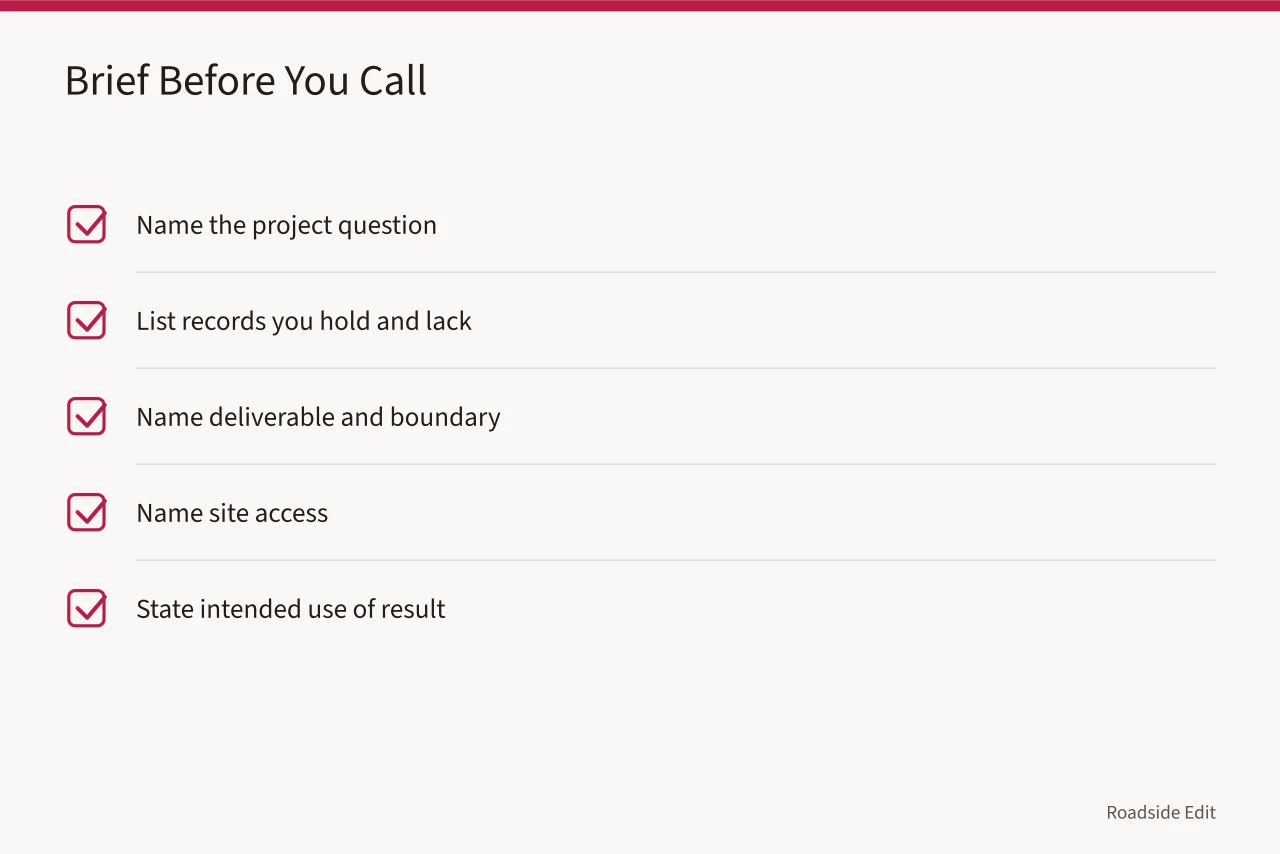
Write the brief before you call anyone. Name the project question. Name the records you hold and the records you lack. Name the deliverable and the boundary of the work. Name site access. State what you intend to do with the result.
Do not send a one-line description such as "renovation help" and expect comparable answers. One studio will price a survey day. Another will price a redrawn elevation. A third will assume the neon is already documented.
| Question | What the answer should clarify |
|---|---|
| What do you understand the project question to be? | Whether the scope is shared. |
| What would you need before recommending anything? | Which records, photographs, or site access are missing. |
| What will you deliver, in what format? | Drawings, report, survey sheets, or a fabrication package. |
| What are you assuming? | Access, existing documentation, condition, approvals, and schedule. |
| What falls outside your role? | Work that needs an engineer, an electrician, or a commission. |
| How do you handle a changed request? | Who authorizes it and how it is recorded. |
For federal negotiated procurements, the Federal Acquisition Regulation requires agencies to set evaluation factors and significant subfactors before award. Read FAR guidance on evaluation factors. Write your comparison factors first, so you are not inventing reasons after you have picked a favorite.
What evidence of relevant experience should you request?
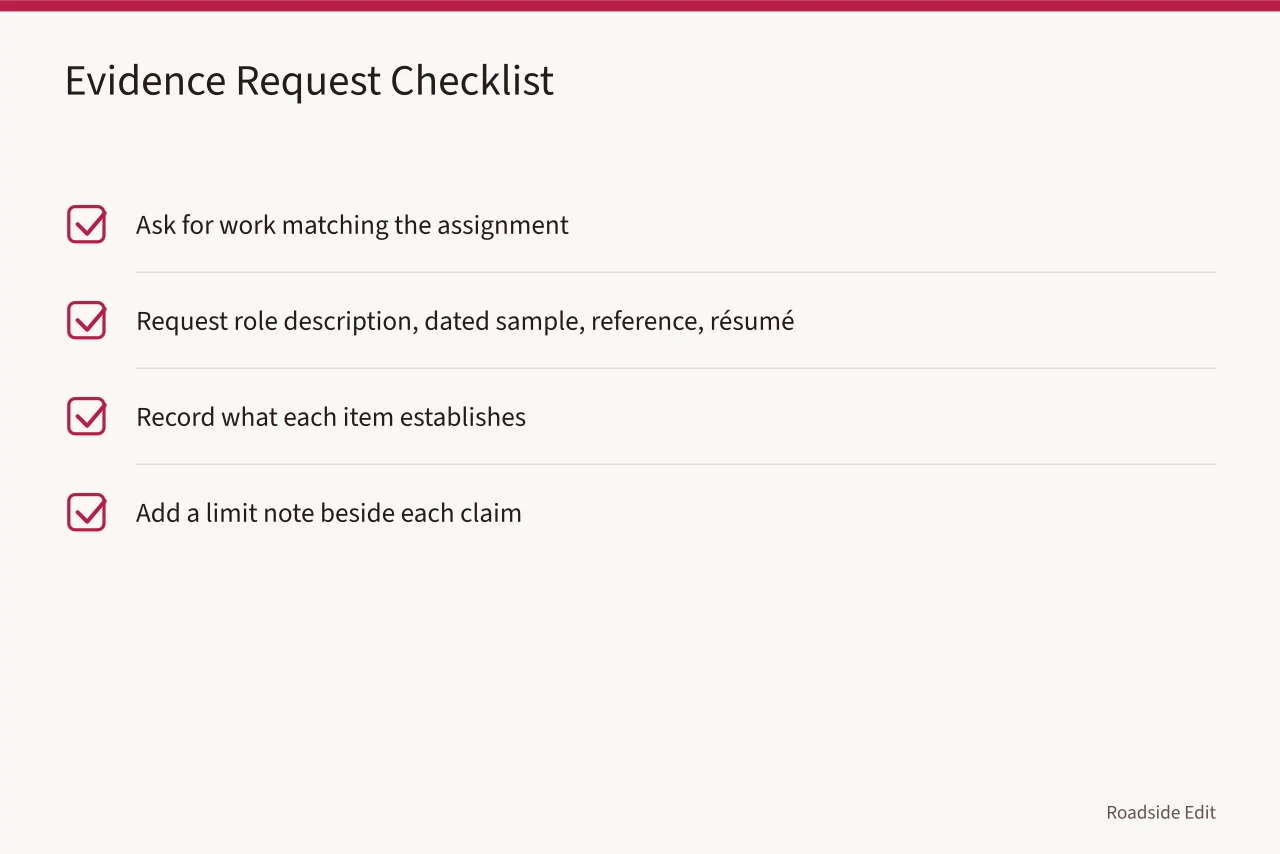
Ask for work that matches the assignment. A studio may send a role description, a dated sample, a reference, or a résumé. Record what each item actually establishes.
A photograph of a restored canopy proves a photograph exists. It does not prove the studio held the contract, that the client was satisfied, or that the same approach suits the client's building.
For preservation work, the National Park Service publishes qualification standards across several disciplines. Review the Secretary of the Interior's Professional Qualification Standards. Use them to ask which expertise your assignment requires, whether that is a historian, an architect, or a materials specialist.
Keep a limit note beside each claim. For example, 'Documented a 1962 sign in 2019' becomes 'Documented a 1962 sign in 2019; does not establish the same result for the client's project.'
Which questions should stay out of the proposal?
Never ask a studio to guarantee a permit, a final cost, a site condition, or a preservation outcome that another party controls. Ask what information and what authority the decision needs instead.
"That sits outside this assignment" and "that needs a site visit first" are signs of a clear boundary. Treat them as good answers.
Worker status is not settled by a title, an invoice, or a contract heading. The IRS looks at the whole relationship and at control and independence. Review the IRS classification guidance. Send the question to the accountant or the agency that applies the test.
Who owns the site, the changes, and the public statements?
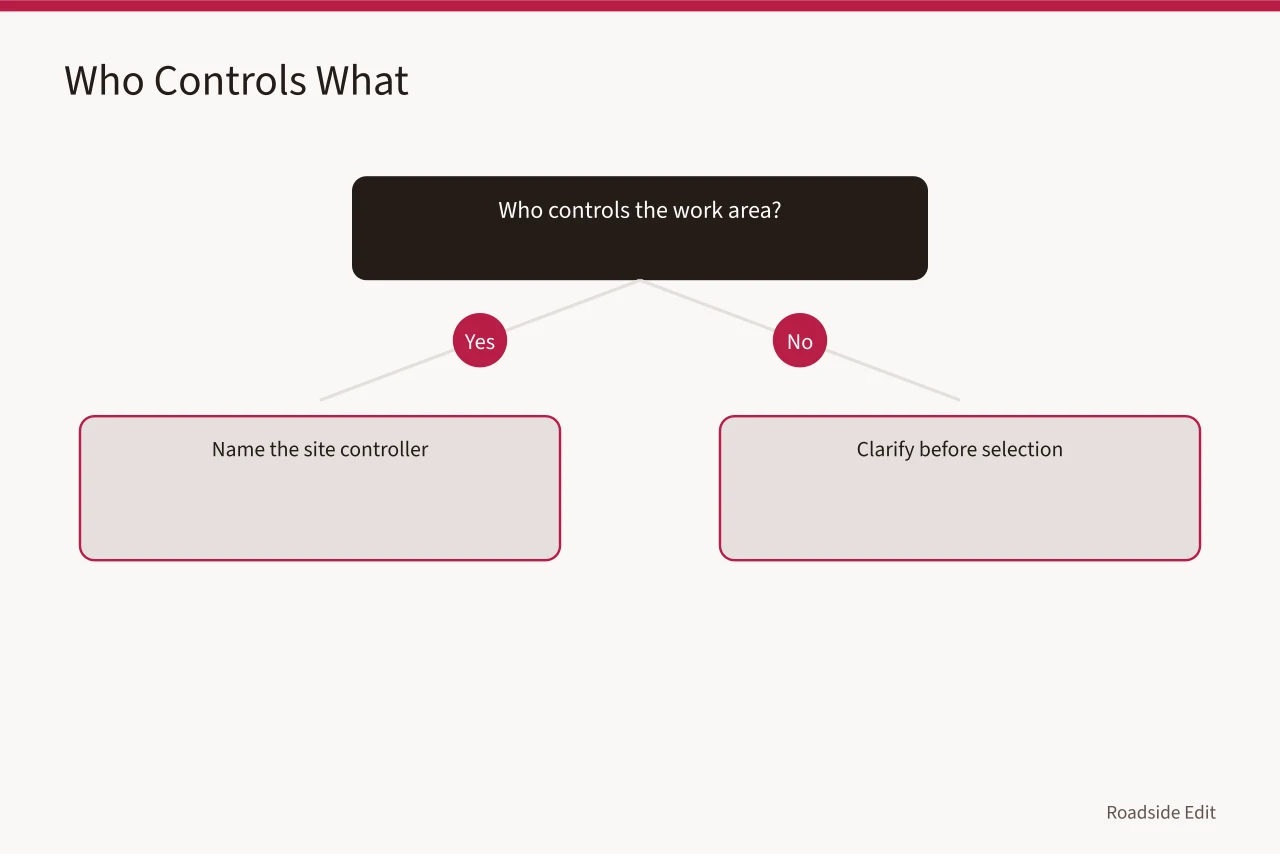
Before you select anyone, decide who controls the work area, who approves a scope change, who confirms a revised cost, and who may speak publicly about the project. These can be four different people.
A proposal can describe an approach. It cannot grant permission, and it does not by itself create a project record.
OSHA's construction standards place accident-prevention duties on covered employers. Consult OSHA's accident-prevention provision. Use it to identify the responsible employer for the relevant site process, not as a safety assurance attached to a bid.
How do you compare the answers without inventing a winner?
Skip the star rating unless the categories and the evidence behind them are visible. Use a narrative record instead. One response covers a field review.
Another is research only. A third assumes access you have not granted. The point is to see the difference.
Before you weigh any of it, ask each studio which employer carries accident-prevention duties on the site, so the safety side of each answer is compared on the same terms.
| Field | What to capture |
|---|---|
| Scope understanding | The studio's own summary |
| Evidence needs | Records or access requested |
| Deliverables | Stated format and timing |
| Assumptions | Conditions the studio names |
| Changes | Proposed change process |
| Public contact | Named source for status |
Records arrive uneven. Say so. A full response from one studio does not make a thin response from another a failing grade when the briefs differed or information was withheld.
The selection owner holds the authority to decide, and that authority does not transfer to a comparison table. Describe the evidence boundary. Do not stand in for the owner.
A worked example: the uneven shortlist
Three studios answer the same brief for a 1957 canopy with a porcelain-enamel fascia panel and a damaged neon tube.
Studio A prices two survey days and a conditions report, and asks for the original sign shop drawings. Studio B prices a redrawn elevation from photographs you send. Studio C assumes the neon is already documented and prices fabrication only.
None of these is wrong. They are three different products. Record the difference, note that Studio C's price rests on an assumption you have not confirmed, and hand the file to the selection owner.
If a studio cites a prior property file as proof of its work, ask which parts of that file it produced and which it inherited before you treat it as evidence. The selection owner should compare all three responses against the brief and the factors written before the call, then decide which gaps to close before any award.
Common questions
Can a studio answer only part of the brief?
Yes, but record which part is covered and do not assume the rest is included in the price.
Is a contract title enough to classify a worker?
No, because classification can turn on facts that a title or a single contract term does not show.
What is the best closing question?
Ask what fact, approval, access problem, or changed condition would alter the proposed work, because the answer tells you how the studio thinks.