Guides
How to decide between new and used sign shop equipment without the jargon
Deciding between new and used sign shop equipment comes down to duty cycle, serviceability, and what the specific machine earns in a typical week.
What to take away
- For new and used sign shop equipment, duty cycle decides. A machine that runs daily for years justifies new; one that runs two days a week rarely does.
- Ask for the meter reading, the service log, and the print head history before you price a used unit.
- Price the install, freight, rigging, and electrical work into the used number, not after it.
- Keep the invoice, the service record, and the depreciation schedule for every asset you buy.
- Confirm electrical, structural, and rigging work with a licensed electrician, a structural engineer, and OSHA 1926 requirements.
This article covers sign-shop business operations. It does not cover sign-code, permitting, electrical, or structural advice. It also does not cover tax advice. Requirements vary by sign, location, substrate, and jurisdiction. Use the authority having jurisdiction and a qualified trade professional.
Start with the duty cycle, not the price
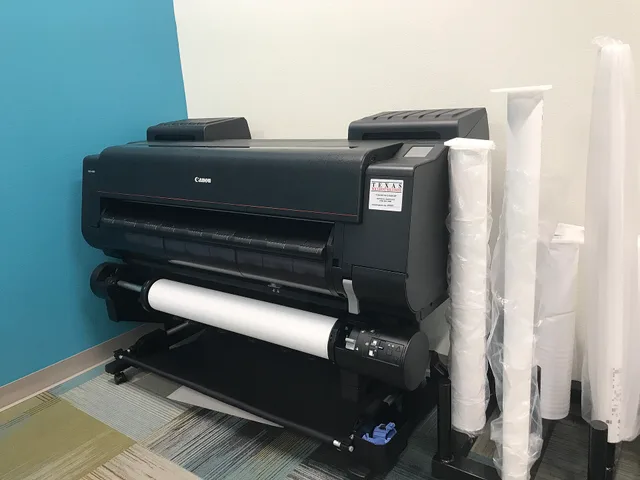
The honest first question is how many hours a week the machine will actually run. A 64-inch eco-solvent printer such as the Roland TrueVIS VG3-640 earns its purchase price back when it runs six hours a day, five days a week.
Run that same printer two afternoons a week and half the throughput does not pay for it. A used unit at half price is the better buy.
Write the number down before you shop. Weekly machine hours, jobs per week, and the largest substrate the shop actually quotes decide more than the sticker does.
New Printer Prices
- $22K–$26KRoland TrueVIS VG3-640
- $20K–$24KMimaki JV300-160 Plus
- $30K–$40KHP Latex 700W
- $5K–$8KGraphtec FC9000-160 cutter
What to check on a used machine
Ask for the meter reading, the service log, and the print head replacement history. A seller who will not produce them is telling you something.
Then inspect the parts that carry the cost:
- Print headscount the missing nozzles on a test print. A Roland DX7 head set typically runs $1,500 to $3,000 installed, and a 64-inch printer carries two.
- Belts, pinch rollers, and feed motorswear here shows as banding and skew, not as a fault code.
- Spindle and vacuum tablecheck for runout and for vacuum loss across the full bed of a used ShopSabre or Multicam router.
- Control board and firmware versionan orphaned board means no parts and no support, a common risk on a Gerber Edge FX.
- Chiller and pump hours on a laser or CNCthese are consumables with a known service life, often 8,000 to 15,000 hours before a rebuild.
A used CNC router with a worn ball screw will cut out of tolerance on acrylic and never tell you why.
The costs the listing leaves out
Freight, rigging, and electrical work often decide the deal. A used flatbed printer that needs a 60-amp circuit and a crane to set may cost more installed than a smaller new unit.
Cost Per Productive Hour
$4.50 | new HP Latex 700W per productive hour
$7.50 | used wide-format printer per productive hour
7,500 hours | new printer over five years at 30 hrs/week
2,000 hours | used printer over five years at 8 hrs/week
Typical add-ons: freight on a used 5x10 flatbed runs $1,500 to $4,000, rigging $1,000 to $3,000, and a new 60-amp circuit $1,200 to $2,500. Calibration and training add a day or two of lost production.
Run the arithmetic in your own numbers:
- Delivered cost = purchase price + freight + rigging + electrical + calibration time.
- Cost per productive hour = delivered cost divided by the hours you will run it over five years.
- Downtime cost = lost jobs per day of outage multiplied by your average job value.
A new HP Latex 700W at $34,000, run 30 hours a week over 50 weeks, spreads over 7,500 hours in five years. That is about $4.50 per productive hour.
A used wide-format printer at $9,000, with $6,000 of freight, heads, and electrical, lands at $15,000 delivered. Run eight hours a week it spreads over 2,000 hours, which is $7.50 per hour before downtime.
Compare that cost per productive hour against a new unit with a warranty. That comparison, not the asking price, is the decision.
Where new wins and where used wins
Fits when
- New purchase (Roland TrueVIS VG3, HP Latex 700W)
- the large-format printer runs daily and carries production
- Used purchase (Roland TrueVIS VG3-640, Mimaki JV300-160 Plus)
- demand is proven but the volume does not yet fill a shift
- Lease (wide-format printer or flatbed cutter)
- the model dates quickly and you want fixed payments
- Rent per job (Zund or Colex flatbed cutter)
- seasonal peaks you can forecast
- Shared or subcontracted (channel letters to a local fabricator)
- another shop nearby already owns the capacity
Trade-off
- New purchase (Roland TrueVIS VG3, HP Latex 700W)
- capital leaves the business before the first order ships
- Used purchase (Roland TrueVIS VG3-640, Mimaki JV300-160 Plus)
- a breakdown in your busiest month costs more than the saving
- Lease (wide-format printer or flatbed cutter)
- exit terms and end-of-term obligations bind you to the lender
- Rent per job (Zund or Colex flatbed cutter)
- every rental day reopens the buy-or-rent question
- Shared or subcontracted (channel letters to a local fabricator)
- scheduling and quality sit outside your control
A shop that subcontracts its channel letters to a specialist fabricator avoids a brake press, a notcher, and the floor space both need. That is a legitimate route, not a failure.
Cutters rarely repay the used route. A new Graphtec FC9000-160 runs roughly $5,000 to $8,000, and a used one at $3,000 saves little against the risk.
Flatbed cutters flip the math. A new Zund G3 or Colex Sharpcut typically runs $60,000 to $120,000, so a used unit at $20,000 to $35,000 with a service log is worth the inspection.
Records that make the decision repeatable
Keep the purchase invoice, the service log, and the depreciation schedule for every asset. The Internal Revenue Service recordkeeping guidance allows any system that clearly shows income and expenses, provided you keep the documents behind purchases, sales, payroll, and assets.
Three Files to Keep
- Purchase invoice for every asset
- Service log with repair history
- Depreciation schedule for tax records
- Safety records and hazard fixes
- Documents behind purchases and sales
Safety records belong in the same file. The OSHA safety management guidance describes a program that finds and fixes hazards before an inspection or injury does. For print and finishing equipment, the OSHA printing industry pages sort standards and hazard recognition by process, including screen printing.
Those three files are purchase, service, and safety. A lender, an insurer, or a buyer will ask for them.
Before you sign
Confirm the electrical supply, the floor loading, and the rigging plan with a licensed electrician and a structural engineer. OSHA 1926 governs the construction-side requirements that apply to installation work.
Then set a reorder point for the consumables the machine eats: vinyl rolls, acrylic sheets, ballast, and ink. A new printer with no ink budget stops the same way a used one does.
If you are still building the shop, the sign shop equipment checklist for new owners covers the sequence, and the sign shop equipment and setup guide covers layout and utilities.
Common questions
How do I price a used printer fairly?
Start from the delivered cost, not the asking price. Add freight, rigging, electrical work, and calibration time, then divide by the hours you expect to run it over five years. Compare that figure against a new unit with a warranty.
What single document should I ask for first?
The service log. It shows what failed, when, and what it cost to fix. A meter reading without a service history tells you how hard the machine worked, not how well it held up.
When is leasing the wrong choice?
When you cannot predict the volume. A five-year lease on a $34,000 HP Latex 700W fixes the payment whether or not the work arrives, and the exit terms usually cost more than the machine saved.
Can I run a sign shop on subcontracted fabrication alone?
Yes, for channel letters, monument signs, and anything needing a brake press or a welder. You trade margin for the capital and floor space you do not spend. Keep the subcontractor's lead time in your quote.